



Blog
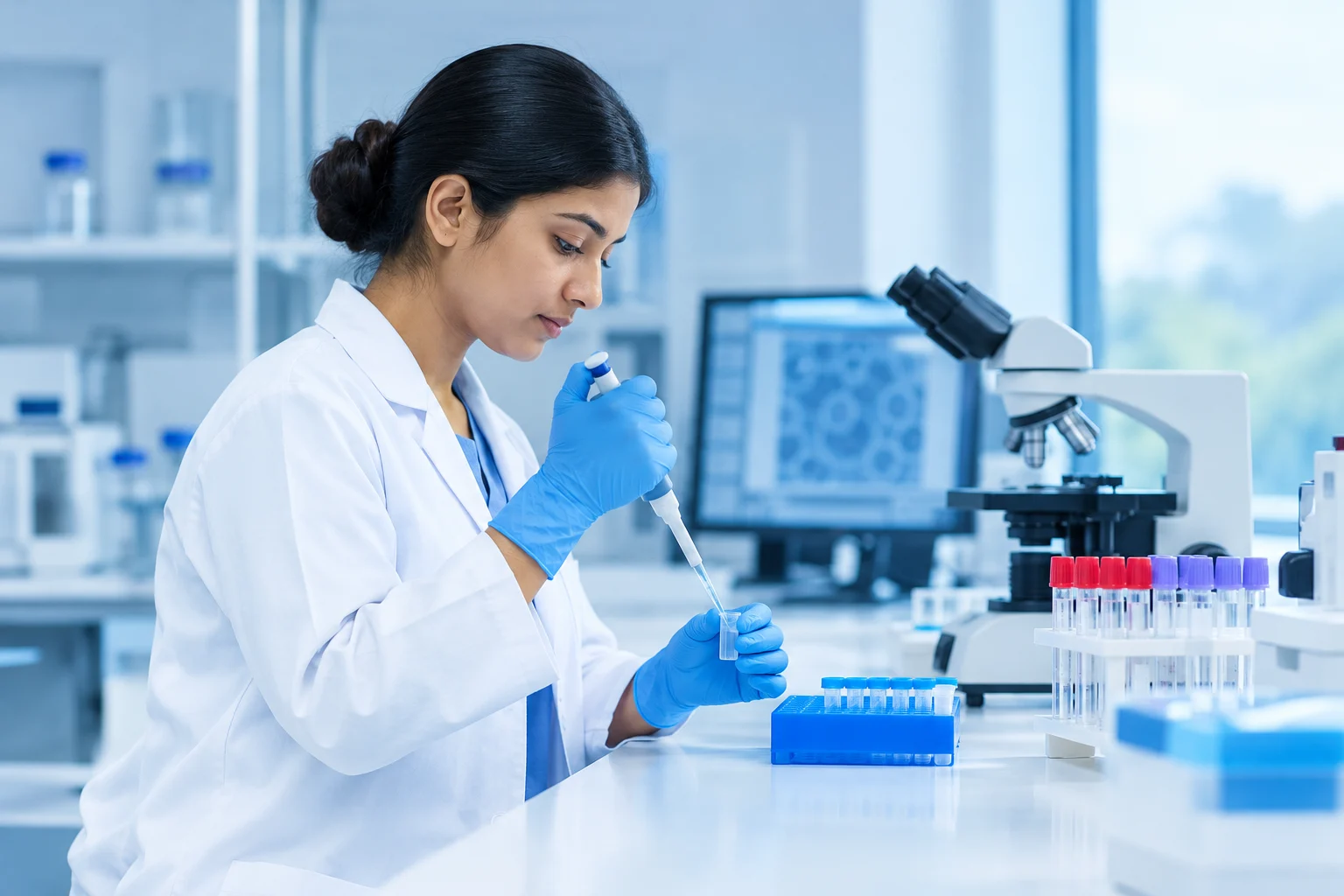
M.Sc. in Medical Laboratory Technology (MLT) in Biochemistry: Complete Guide to the Course at HIHS Haldia
Every diagnosis that a doctor makes with confidence rests on a laboratory report that someone had to produce, validate and interpret with precision. Behind a blood sugar reading, a liver function profile or a kidney panel stands a trained professional who understands both the chemistry of the human body and the instruments that measure it. For graduates of medical laboratory technology who wish to move from performing tests to leading laboratories, the M.Sc. in Medical Laboratory Technology (MLT) in Biochemistry is one of the most rewarding postgraduate routes available.
Haldia Institute of Health Sciences (HIHS), established in 2003 by the Indian Centre for Advancement of Research and Education (ICARE), offers this specialised postgraduate programme from its campus in Haldia. This guide explains what the M.Sc. MLT in Biochemistry course involves, who can apply, how admission works, what you will study and where the qualification can take your career.
Why Biochemistry Is the Beating Heart of the Diagnostic Laboratory
Clinical biochemistry is the branch of laboratory medicine that studies the chemical composition of blood, urine and other body fluids. When a physician orders tests for blood glucose, cholesterol, bilirubin, creatinine, electrolytes or cardiac enzymes, the results come from a biochemistry laboratory. These numbers help doctors detect diabetes, monitor kidney and liver disease, assess heart attacks, manage metabolic disorders and track how a patient responds to treatment.
Because so many clinical decisions depend on these results, hospitals and diagnostic centres need laboratory professionals who can do more than run samples. They need people who understand quality control, can troubleshoot instruments, can recognise when a result does not fit the clinical picture and can supervise junior technicians. The M.Sc. MLT in Biochemistry is designed to build exactly this level of expertise on top of an undergraduate foundation in medical laboratory technology.
M.Sc. MLT in Biochemistry at HIHS Haldia: The Course at a Glance
A Small, Focused Cohort
The programme has an intake capacity of six students. Such a small batch is unusual in postgraduate education, and it means that every student can expect closer supervision, more practical exposure and greater access to faculty than in a crowded classroom. Admission is therefore competitive, so early preparation is wise.
Who Is Eligible
To apply, a candidate must hold a Bachelor of Medical Laboratory Technology or a B.Sc. in Medical Laboratory Technology from a recognised university. This requirement ensures that every student entering the course already understands basic laboratory practice, so that the postgraduate years can be spent on advanced concepts rather than fundamentals.
How Admission Works
Admission is through JEMAS-PG, the postgraduate entrance examination conducted by the West Bengal Joint Entrance Examination Board (WBJEEB). Candidates should keep an eye on the official WBJEEB website for notifications about application dates, eligibility details and counselling schedules.
What You Will Study: A Syllabus Built Around the Human Body and the Laboratory
The curriculum blends medical sciences, laboratory disciplines and research skills. The syllabus outline published by HIHS covers Human Anatomy, Human Physiology, Clinical Biochemistry, Community Medicine, Clinical Pathology, Histopathology and Cytopathology, Clinical Microbiology, Haematology and Immunology. It also includes Communicative English, Computer Application, Endocrinology, Research Methodology and Biostatistics, Environment Science and Health, Laboratory Instrumentation, Serology, Blood Bank and Blood Transfusion, Molecular Biology and Genetics, Pharmacology and Toxicology, Enzymology, and Advanced Diagnostic Approaches.
The Biochemistry Core
Clinical Biochemistry and Enzymology form the centre of the programme. Students learn how metabolic pathways work, how enzymes behave in health and disease and how changes in the concentration of particular substances in blood point towards specific conditions. Endocrinology adds the hormonal dimension, helping students understand disorders of the thyroid, pancreas and other glands that laboratories investigate every day.
The Wider Laboratory Picture
A biochemist who works in a hospital laboratory rarely works in isolation. Subjects such as Haematology, Immunology, Serology, Clinical Microbiology and Blood Bank and Blood Transfusion give students a working knowledge of neighbouring departments, so that they can interpret results in context and communicate effectively with pathologists, physicians and fellow technologists.
Research, Statistics and Modern Diagnostics
Research Methodology and Biostatistics teach students how to design a study, analyse data and read scientific literature critically, skills that are valuable both in academic research and in laboratory quality assurance. Molecular Biology and Genetics, together with Advanced Diagnostic Approaches, introduce the techniques that are steadily changing how diseases are detected and monitored. Laboratory Instrumentation, meanwhile, ensures that graduates are comfortable with the analysers and equipment on which a modern laboratory depends.
Skills That Go Beyond the Textbook
A postgraduate degree in this field is not only about knowledge; it is about professional judgement. Over the course, students are expected to develop accuracy and attention to detail, because even a small error in sample handling or calculation can alter a patient's report. They learn to follow quality control procedures, to maintain laboratory records responsibly and to work within safety standards for handling biological material and chemicals.
Equally important are communication and leadership. The inclusion of Communicative English and Computer Application in the syllabus reflects the reality that laboratory professionals must write clear reports, use laboratory information systems and explain technical matters to colleagues and patients.
Career Prospects After M.Sc. MLT in Biochemistry
Graduates of this programme can pursue several distinct paths, and the breadth of options is one of its strongest selling points.
Senior Roles in Hospitals and Diagnostic Centres
Qualified candidates can work as Chief Medical Laboratory Technician, Senior Medical Laboratory Technician or Quality Control Officer in central and state government hospitals, private hospitals, diagnostic centres and nursing homes. These positions carry supervisory responsibility, and the postgraduate qualification gives candidates a clear advantage over those with only a bachelor's degree.
Starting Your Own Laboratory
For the entrepreneurially minded, the qualification provides the technical credibility to set up an independent diagnostic centre or pathology laboratory. With demand for reliable testing growing in towns and cities across India, a well-run laboratory led by a trained biochemist can become a trusted local healthcare provider.
Teaching in Medical Laboratory Technology Institutions
Those who enjoy mentoring others can join a college or institution that teaches medical laboratory technology as an Assistant Professor. A postgraduate degree is the foundation of an academic career, and teaching allows graduates to shape the next generation of laboratory professionals.
Research Careers
After qualifying the NET or an equivalent examination, graduates can become a Junior Research Fellow or a Research Associate on government-sponsored research projects at prestigious institutions.
Opportunities in the Food and Beverage Industry
The analytical and quality control skills developed during the course are also valued outside healthcare. Graduates can find employment in food and beverage industries, where laboratory testing is essential for safety, consistency and compliance.
Why Choose HIHS Haldia for Your Postgraduate Studies
Haldia Institute of Health Sciences was established in 2003 by ICARE and has since grown into a recognised name in paramedical and health sciences education in West Bengal. The institute is located within the ICARE Complex at Hatiberia in Haldia, in Purba Medinipur district, a setting that places students close to the hospitals, industries and healthcare institutions of the region.
The institute's Department of Medical Laboratory Technology offers a progression of programmes, including the Bachelor of Medical Laboratory Science (BMLS), the Diploma in Medical Laboratory Technology (DMLT) and M.Sc. specialisations in Biochemistry, Microbiology and Immuno Haematology and Blood Banking. This means that a student can build a complete pathway in laboratory science within a single institution. With only six seats in the biochemistry programme, learners also benefit from attention that larger classes cannot provide.
Is This Course Right for You?
This programme suits graduates who enjoy chemistry and biology in equal measure, who are comfortable with precise, methodical work and who want to take on responsibility within a healthcare team. It is especially suitable for BMLT and B.Sc. MLT graduates who have found themselves drawn to the biochemical side of laboratory work and wish to deepen that interest into a specialisation. If you also see yourself teaching, researching or running a laboratory one day, the M.Sc. MLT in Biochemistry offers the flexibility to move in any of those directions.
How to Apply
Prospective students should first confirm that they meet the eligibility requirement, then prepare for and appear in JEMAS-PG through WBJEEB. After the results and counselling process, selected candidates can complete admission formalities with the institute. For guidance on the process, documents and current admission status, candidates may use the admission enquiry facility on the HIHS website or contact the institute directly using the details below.
Frequently Asked Questions
What is the eligibility for M.Sc. MLT in Biochemistry at HIHS Haldia?
Candidates must have completed a Bachelor of Medical Laboratory Technology or a B.Sc. in Medical Laboratory Technology from any recognised university.
How many seats are available in the course?
The intake capacity is six, so competition for places is considerable and early preparation is sensible.
Which entrance examination is required for admission?
Admission is through JEMAS-PG, which is conducted by the West Bengal Joint Entrance Examination Board.
What jobs can I get after completing M.Sc. MLT in Biochemistry?
Graduates can work as Chief or Senior Medical Laboratory Technician or as Quality Control Officer in government and private hospitals, diagnostic centres and nursing homes. They can also set up their own diagnostic centre or pathology laboratory, teach as an Assistant Professor, work in research as a Junior Research Fellow or Research Associate after qualifying NET, or find roles in the food and beverage industry.
Can I become a college lecturer after this degree?
Yes. Graduates can join a medical laboratory technology college or institution as an Assistant Professor. Those who qualify NET or an equivalent examination can also move into research fellowships.
Does the syllabus include research training?
Yes. Research Methodology and Biostatistics, along with Molecular Biology and Genetics and Advanced Diagnostic Approaches, prepare students for both research and advanced laboratory practice.
Contact Us
If you would like to know more about the M.Sc. MLT in Biochemistry programme or the admission process, the HIHS team will be glad to help. You can call or message on +91 9153294484, write to principalhihs@gmail.com, or visit the institute at ICARE Complex, Hatiberia, Haldia, Purba Medinipur, West Bengal, India, Pin 721657. The complete course details are also available on the official HIHS course page.

