



Blog
Bachelor of Emergency Medical Technologist (BEMT): Complete Guide to the Course at the Best Paramedical College in West Bengal 2026
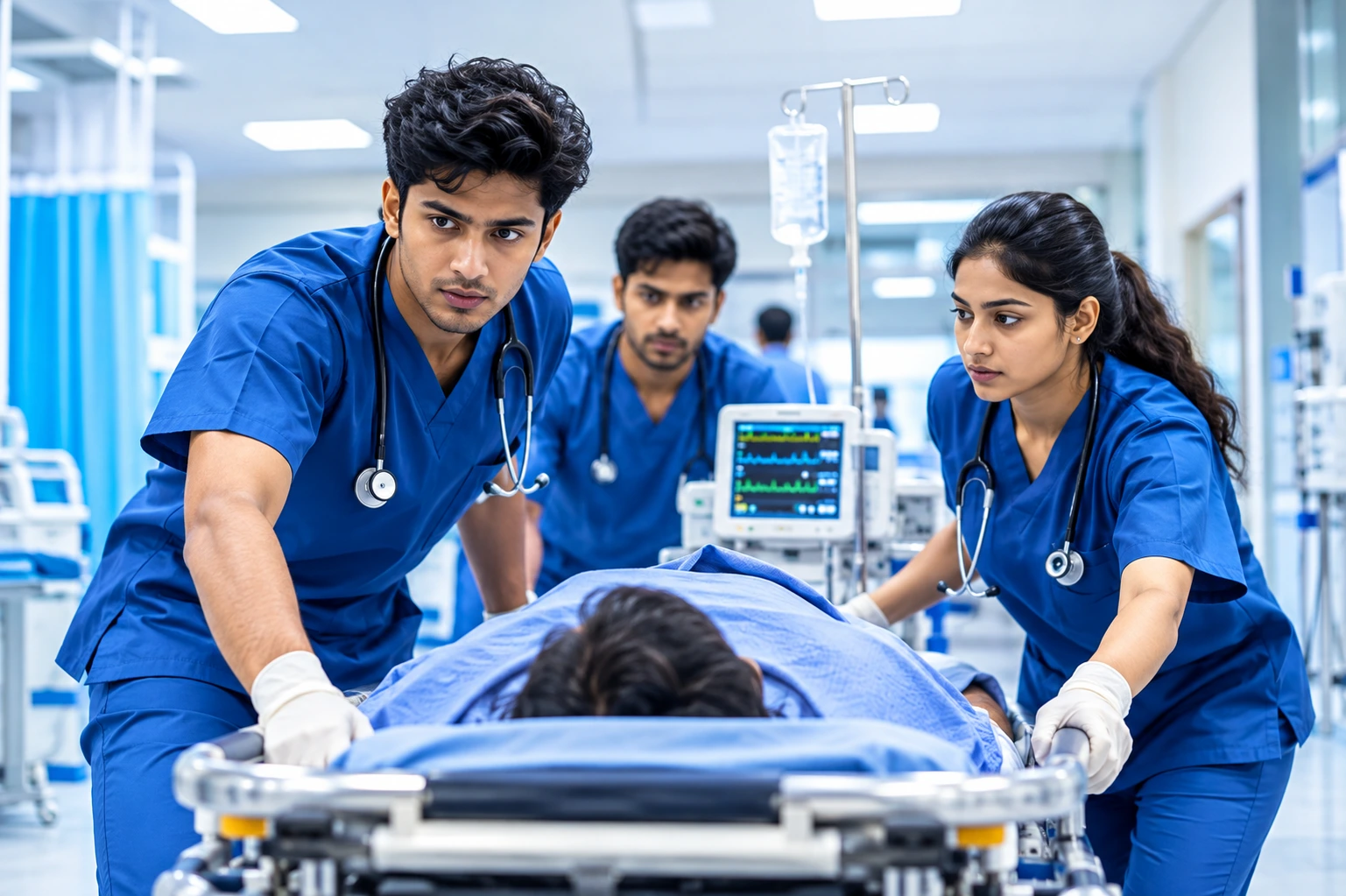
Every minute counts when someone is injured in a road accident, suffers a cardiac arrest or faces a sudden medical crisis. The first few minutes of care often decide whether a patient recovers fully, and the professionals who deliver that care are emergency medical technologists. As India’s healthcare system expands, hospitals, trauma centres and emergency services need trained people who can stay calm under pressure and act with precision.
If you want a career that places you at the centre of life-saving action, the Bachelor of Emergency Medical Technologist (BEMT) is a rewarding choice. Haldia Institute of Health Sciences (HIHS) offers this programme as part of its allied health portfolio. This guide explains the duration, eligibility, syllabus and career scope of the BEMT course, and shows why HIHS is a leading choice for students searching for the best paramedical college in West Bengal.
What Is the Bachelor of Emergency Medical Technologist (BEMT) Course?
The Bachelor of Emergency Medical Technologist (BEMT) is a four-year undergraduate programme that prepares students to support patients in emergency and critical care situations. Emergency medical technologists work alongside doctors, nurses and other healthcare staff to assess patients, assist with life-support procedures and ensure safe handling during the most urgent moments of treatment.
The programme blends classroom learning in the medical sciences with practical training in clinical settings. Rather than focusing on a single speciality, BEMT introduces students to a wide range of departments, from surgery and anaesthesia to paediatrics and neurology, so that graduates can respond confidently to many kinds of emergencies.
BEMT Course Overview at HIHS Haldia
The BEMT programme at HIHS runs for four years, and this includes one year of internship, which gives students sustained hands-on exposure before they enter the profession. The intake capacity is fifty students, a number that keeps classes focused and allows faculty members to give attention to each learner. The course is offered by the Department of Science and Management at HIHS, which is affiliated with the West Bengal University of Health Sciences (WBUHS).
Role of an Emergency Medical Technologist in Healthcare
An emergency medical technologist is often among the first members of a healthcare team to meet a critically ill or injured patient. Their responsibilities include helping to stabilise patients, supporting doctors during urgent procedures, monitoring vital signs and ensuring that equipment and supplies are ready when seconds matter. In a busy emergency department, this support allows doctors and nurses to concentrate on diagnosis and treatment.
Their work does not end with the emergency itself. Technologists also help maintain hygiene standards, assist in patient transfers and coordinate with laboratory and imaging teams. This wide responsibility is why the BEMT syllabus covers so many medical disciplines instead of limiting itself to one.
BEMT Eligibility Criteria for Admission
Candidates must have passed the higher secondary examination or its equivalent with at least 50 per cent marks in Physics, Chemistry and Biology. Because the course draws on the biological and physical sciences from the very first year, this science background is essential. Students who have completed Class 12 in the science stream with Biology as a subject are therefore well placed to apply.
Prospective students should keep their mark sheets and certificates ready and check the latest admission notices on the official HIHS website. Admission queries can be directed to the institute’s admission office, whose contact details appear at the end of this guide.
BEMT Syllabus: What Will You Study?
The BEMT curriculum is designed to move gradually from scientific foundations to specialised emergency and critical care practice.
The BEMT curriculum moves from scientific foundations to specialised emergency and critical care practice. Early subjects such as Human Anatomy and Physiology, Biochemistry and Pharmacology build an understanding of how the body works, how disease develops and how medicines act in emergencies. The clinical phase covers Basic Anaesthesia, Surgery and Basic and Advanced Critical Care Science, supported by Haematology and Imaging Studies for reading diagnostic reports. CSSD training teaches infection control and the safe handling of sterile equipment. Subjects like Clinical Medicine, Paediatrics and Orthopaedics prepare students for the wide range of cases an emergency team may face.
The Internship Year
The final year is devoted to internship. Working in a real healthcare environment, interns apply classroom knowledge to actual patient care, learn teamwork in high-pressure settings and build the confidence that employers look for in new recruits.
Skills You Will Develop During the BEMT Programme
Beyond subject knowledge, the BEMT programme shapes a distinct professional mindset. Students develop quick decision-making and the ability to stay composed when situations change rapidly. They learn to communicate clearly with patients, anxious families and fellow clinicians. Teamwork, physical readiness and attention to safety become second nature.
Technical competence in assisting with critical care procedures, understanding diagnostic findings and maintaining sterile conditions prepares graduates to contribute from their first day at work. Compassion is equally important, since emergency professionals meet people at their most vulnerable moments.
Who Should Choose the BEMT Course?
This course suits students who are curious about the human body, comfortable with responsibility and motivated by the idea of helping others in difficult moments. If you enjoy science, work well in a team and prefer an active, hands-on profession to a desk-based one, BEMT can be an excellent fit. It also suits students who want a clear, skill-based career path in healthcare without the long duration of a medical degree.
Students should also be prepared for the physical and emotional demands of the field. Emergency care involves long hours, quick movement and exposure to distressing situations. Those who develop resilience, empathy and discipline during their training tend to thrive, and the structured internship at HIHS gives them a realistic preview of what working life involves before they graduate.
Career Scope After BEMT
Demand for trained emergency and critical care staff continues to grow as hospitals strengthen their emergency departments and intensive care units. Graduates of the Bachelor of Emergency Medical Technologist programme can pursue several pathways.
Successful graduates may be appointed as Critical Care Technicians in central or state government hospitals and healthcare services. This is a respected route that places professionals in settings where they contribute to patient care every day.
Those who enjoy teaching can be recruited as Demonstrators or Clinical Tutors at institutes that conduct courses in critical care technology, helping to train the next generation of healthcare workers. The programme also opens the option of working as a Medical Transcriptor.
Because the training covers emergency and critical care in depth, graduates are also well prepared to explore opportunities in hospital emergency departments, intensive care units and emergency response services, subject to the recruitment norms of each employer. Students who wish to study further can also consider higher education in allied health sciences after completing the degree.
Why Choose HIHS Haldia for the BEMT Course?
Haldia Institute of Health Sciences was established in 2003 by the Indian Centre for Advancement of Research and Education (ICARE). For more than two decades, the institute has trained healthcare professionals in Purba Medinipur and the surrounding districts. Its campus at the ICARE Complex in Hatiberia, Haldia, gives students a focused academic environment dedicated to health sciences.
HIHS belongs to the ICARE family, which also includes ICARE Institute of Medical Sciences and Research and Dr. Bidhan Chandra Roy Hospital in Haldia. Studying within a group that is deeply rooted in healthcare helps students see the connection between classroom learning and real patient needs.
The location is another advantage. Haldia is an important industrial and port town of West Bengal, and the surrounding region has a steady need for skilled healthcare workers. Students who study here learn in a setting where the importance of emergency preparedness is easy to appreciate.
The limited intake of fifty students supports personal mentoring, while the one-year internship ensures that graduates leave with practical experience, not just theory. HIHS also provides information on scholarships for eligible students, which can make quality paramedical education more accessible. Taken together, these strengths explain why many families consider HIHS among the top paramedical colleges in West Bengal for emergency medical technology.
Frequently Asked Questions (FAQs)
What is the duration of the BEMT course at HIHS Haldia?
The course lasts four years, including one year of internship.
What is the eligibility for the Bachelor of Emergency Medical Technologist course?
Candidates need a pass in higher secondary or its equivalent with 50 per cent marks in Physics, Chemistry and Biology.
How many seats are available in the BEMT programme?
The intake capacity is fifty students.
What jobs can I get after completing BEMT?
Graduates may work as Critical Care Technicians in government hospitals and healthcare services, as Demonstrators or Clinical Tutors, or as Medical Transcriptors.
How can I apply for the BEMT course at HIHS?
You can submit an admission enquiry through the official HIHS website or contact the admission office by phone or email.
Contact Us
Start your journey towards a life-saving career with Haldia Institute of Health Sciences. For admission details, call +91-9153294484 or write to principalhihs@gmail.com
Address: ICARE Complex, Hatiberia, Haldia, Pin 721657, Purba Medinipur, West Bengal, India.

