



Blog
M.Sc. in Laboratory Technology (Immuno Haematology & Blood Banking): Course, Career and Future Scope
The healthcare sector is evolving rapidly, and laboratory sciences have become one of the most critical pillars of modern medical systems. Accurate diagnosis, safe blood transfusion practices, and disease detection all depend heavily on skilled laboratory professionals. Among the most specialized fields in this domain is M.Sc. in Laboratory Technology (Immuno Haematology & Blood Banking), a program designed to train experts in blood analysis, transfusion science, and immunological testing.
At Haldia Institute Of Health Sciences, this program is designed to meet industry standards while preparing students for real-world healthcare challenges. The course not only builds technical expertise but also develops analytical thinking and precision, which are essential in laboratory environments.
Understanding the Course
The M.Sc. in Laboratory Technology (Immuno Haematology & Blood Banking) focuses on the scientific study of blood, its components, and immune responses related to transfusion practices. It is a postgraduate program that combines theoretical knowledge with hands-on laboratory training.
Students learn how blood is collected, tested, stored, and safely transfused. They are also trained in identifying blood groups, detecting antibodies, and ensuring compatibility between donors and recipients. This specialization plays a crucial role in saving lives, especially in emergency and surgical situations.
Why This Course is Important in Modern Healthcare
Healthcare today relies heavily on precision and safety. Blood transfusion errors can be life-threatening, which makes trained professionals in immuno haematology extremely valuable.
With increasing demand for blood banks, diagnostic laboratories, and advanced medical facilities, the need for experts in M.Sc. in Laboratory Technology (Immuno Haematology & Blood Banking) is growing steadily. Hospitals and healthcare institutions require skilled professionals who can maintain accuracy and follow strict protocols.
This field is not only about technical work but also about responsibility. Every test conducted and every unit of blood processed directly impacts patient health.
Course Structure and Learning Experience
The program at Haldia Institute Of Health Sciences offers a balanced mix of theory and practical training. Students study key subjects such as Human Anatomy, Human Physiology, Clinical Biochemistry, Community Medicine, Clinical Pathology, Histopathology & Cytopathology, Clinical Microbiology, Haematology, and Immunology, along with areas like Blood Bank & Blood Transfusion, Molecular Biology & Genetics, Pharmacology & Toxicology, Enzymology, and Advanced Diagnostic Approaches. The course also includes Communicative English, Computer Application, Research Methodology & Biostatistics, Environment Science & Health, and Laboratory Instrumentation.
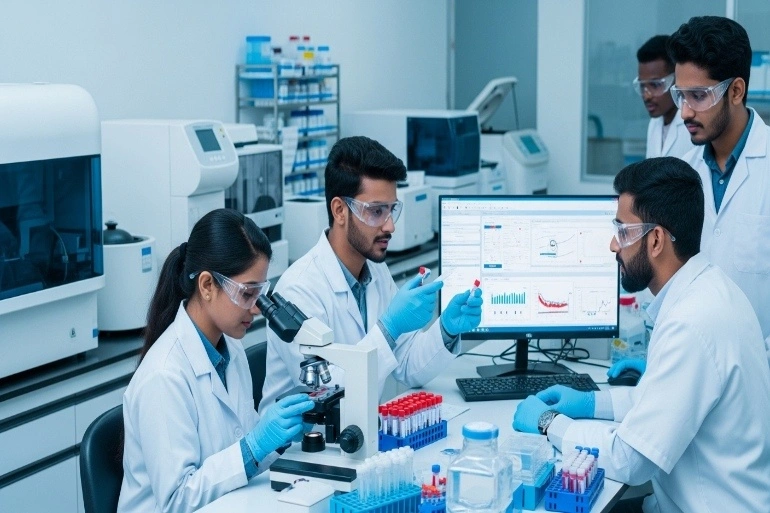
Practical laboratory training is a major focus, where students work with modern equipment and learn real hospital procedures, making them job-ready. The curriculum also highlights quality control, safety standards, and ethical practices essential in healthcare settings.
Eligibility and Admission Process
Admission to the M.Sc. in Laboratory Technology (Immuno Haematology & Blood Banking) requires candidates to have completed a Bachelor of Medical Laboratory Technology or a B.Sc. in Medical Laboratory Technology from a recognized university. The selection process is conducted through JEMAS-PG, organized by the West Bengal Joint Entrance Examination Board, ensuring a fair, transparent, and merit-based admission system for aspiring students.
Skills Developed During the Course
Students pursuing this program develop a wide range of skills that are highly valued in the healthcare industry. These include analytical thinking, attention to detail, technical proficiency, and problem-solving abilities.
They also learn how to handle sensitive medical data, maintain laboratory records, and follow strict hygiene and safety protocols. Communication skills are equally important, as professionals often work closely with doctors and healthcare teams.
Career Opportunities After the Course
Graduates of M.Sc. in Laboratory Technology (Immuno Haematology & Blood Banking) can explore careers in hospitals, blood banks, diagnostic labs, research institutions, and healthcare organizations as technologists, lab managers, or transfusion specialists.
They can also work as Chief or Senior Medical Laboratory Technicians and Quality Control Officers in government and private hospitals, diagnostic centres, and nursing homes. Opportunities extend to starting their own diagnostic labs, joining academic institutions as Assistant Professors, pursuing research roles after qualifying NET, and even working in the food and beverage industry.
Growing Demand in India and Globally
The demand for skilled laboratory professionals is increasing not only in India but also globally. With advancements in medical technology and rising healthcare awareness, the need for accurate diagnostics and safe blood transfusion practices is higher than ever.
Programs like M.Sc. in Laboratory Technology (Immuno Haematology & Blood Banking) prepare students to meet these demands effectively. The global healthcare industry offers numerous opportunities for qualified professionals.
Role of Technology in Laboratory Sciences
Technology has transformed laboratory practices significantly. Automated machines, digital reporting systems, and advanced diagnostic tools have improved accuracy and efficiency.
Students in this program learn to work with modern laboratory equipment and software, preparing them for technologically advanced workplaces. Understanding these tools is essential for delivering reliable results.
Why Choose Haldia Institute Of Health Sciences
Haldia Institute Of Health Sciences is known for its commitment to quality education and practical training. The institute provides modern laboratory facilities, experienced faculty, and a curriculum aligned with industry needs.
Students benefit from a supportive learning environment that encourages innovation and skill development. The institute focuses on preparing students for real-world challenges, ensuring they are confident and competent professionals.
Future Scope of the Course
The future of M.Sc. in Laboratory Technology (Immuno Haematology & Blood Banking) is highly promising. As healthcare systems continue to expand, the demand for specialized laboratory professionals will keep growing.
Opportunities in research, advanced diagnostics, and healthcare management are also increasing. Professionals in this field can contribute to medical advancements and play a vital role in patient care.
Conclusion
The field of immuno haematology and blood banking is essential for modern healthcare. A program like M.Sc. in Laboratory Technology (Immuno Haematology & Blood Banking) offers the knowledge, skills, and practical experience needed to build a successful career in this domain.
At Haldia Institute Of Health Sciences, students are equipped with the expertise required to excel in laboratory sciences and contribute meaningfully to the healthcare sector. For those passionate about science, precision, and saving lives, this course provides a strong foundation and a rewarding career path.
Contact Us
If you are interested in pursuing M.Sc. in Laboratory Technology (Immuno Haematology & Blood Banking) and want to build a successful career in the healthcare and diagnostic field, Haldia Institute Of Health Sciences is here to guide you at every step. Our experienced faculty and modern facilities ensure that you receive the right knowledge, practical exposure, and industry-ready skills.
Feel free to reach out to us for more information about admissions, eligibility, course details, and career opportunities. Connect with our team today and take the first step towards a rewarding future in laboratory sciences and healthcare.

