



Blog
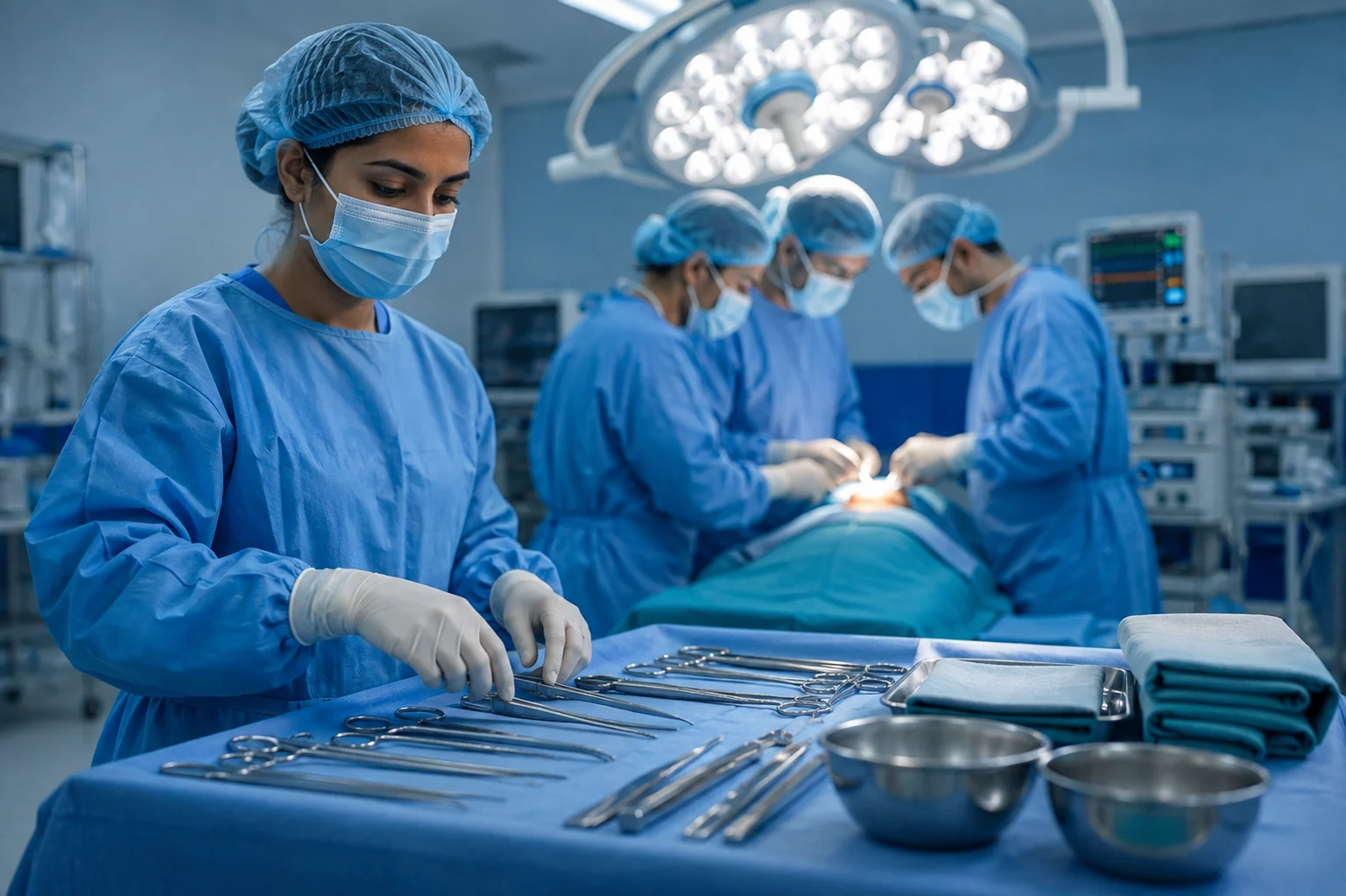
Diploma in Operation Theater Technology (DOTT) : Your Complete Guide to a Career as an OT Technician
West Bengal's hospital sector has expanded steadily over the past decade, and with it has come a growing need for skilled support staff who can work directly inside the operation theatre. If you are a Class 12 science student wondering how to enter healthcare without committing to a long degree programme, the Diploma in Operation Theater Technology (DOTT) is worth serious consideration. It is a shorter, practically focused pathway into one of the most essential roles in any hospital - the Operation Theatre Technician - and it is offered at Haldia Institute of Health Sciences (HIHS), giving students across Purba Medinipur and the wider region a credible, locally accessible option.
Understanding the DOTT Course
The DOTT is a diploma-level programme with a total duration of two and a half years, which includes a six-month supervised internship built into that timeline. Admission is not done directly through the institute but through counselling conducted by the State Medical Faculty of West Bengal, which oversees eligibility verification and seat allocation across affiliated institutions. At HIHS, the intake for this programme is deliberately kept small, at six seats, which allows for closer, hands-on supervision during practical training - an important factor in a course built around surgical support skills.
To be eligible, candidates must have passed Physics, Chemistry, and Biology separately, with an aggregate of at least 50% marks in their 10+2 or equivalent examination. This keeps the entry criteria accessible to a broad range of science students while still ensuring a baseline of scientific grounding needed to understand human anatomy, pharmacology, and surgical procedure.
What You Will Study
The DOTT syllabus is designed to take a student from foundational medical science through to the exact procedural skills a live operation theatre demands - from understanding the body itself to knowing precisely how a trolley should be laid for a dozen different kinds of surgery. It is a curriculum built quietly around one goal: making sure that by the time a student walks into a real OT, nothing about it feels unfamiliar.
What Makes This Course Practical
Duration and structure: At two and a half years, including a built-in six-month internship, the DOTT is considerably shorter than a full undergraduate degree. For students who want to start earning sooner rather than later, this is one of the clearest advantages of the diploma route.
Hands-on emphasis: Because the syllabus moves quickly from foundational science into applied surgical training, students spend a substantial portion of the course developing practical skills - instrument handling, trolley preparation, sterilisation protocol, and assisting during procedures - rather than spending years on theory alone.
Small intake, closer supervision: With only six seats available at HIHS, students benefit from more individual attention during practical sessions, which matters considerably in a field where precision and procedure are non-negotiable.
Entry point into a specialised field: The DOTT gives students direct entry into operation theatre work without requiring them to first complete a broader paramedical or nursing qualification, making it one of the more direct routes into surgical support roles.
Who Should Choose DOTT?
DOTT suits students who know they want to work close to surgical care and who would rather begin their careers sooner than spend three to four years on a full degree first. It is a good fit for those who enjoy structured, procedure-based work and who are comfortable with the physical and disciplined nature of operation theatre duties. Students from smaller towns and semi-urban parts of West Bengal, for whom a shorter and more affordable course is often the more realistic option, will find the DOTT at HIHS a practical way to enter the healthcare workforce while staying close to home.
It is also a sensible choice for students who are not yet certain they want to commit to a long academic pathway but who want to keep their options open. As explained further below, a diploma is not necessarily the end of the road academically.
Career Scope After DOTT
On completing the DOTT, graduates are qualified to work as Operation Theatre Technicians in Central and State Government hospitals, private hospitals, and nursing homes. This is a role in constant demand: every surgical procedure, from routine day-care operations to major surgeries, requires a trained technician to prepare the theatre, arrange instruments correctly, maintain sterile conditions, and assist the surgical team throughout the procedure.
Because the training touches on multiple surgical specialities rather than just one, DOTT graduates are generally able to work across different departments within a hospital, which broadens their employability. With experience, technicians can move into more senior operation theatre roles, take on training responsibilities for newer staff, or specialise further in a particular surgical area they have developed an interest in during their internship or early career.
Demand for trained OT support staff in West Bengal has remained steady as both government and private hospital infrastructure across the state continues to expand, particularly in tier-two towns and industrial belts such as Haldia, where new nursing homes and diagnostic centres regularly need qualified technicians. For students who complete their internship with a strong record, that placement can often become the first step into a permanent role at the same institution, giving DOTT graduates a realistic and fairly direct route from classroom to employment.
Can You Build on DOTT Later?
Choosing a diploma first does not close the door on further study. Students who complete the DOTT and later decide they want a more academically advanced qualification in the same field can look at the B.Sc. in Operation Theatre Technology (B.Sc. OTT), also offered at HIHS, which is a full undergraduate degree covering the same core subject area in greater depth. While the specific lateral-entry pathway and any credit exemptions should always be confirmed directly with the admissions office at the time of application, the general principle holds: a DOTT graduate has real, practical experience already in hand, and pursuing a degree afterwards is a natural next step for those who develop a taste for the field and want to move into more senior or specialised roles over time.
This makes the DOTT a genuinely flexible starting point - useful on its own for students who want to start working quickly, and equally useful as a foundation for those who later decide they want to study further.
Why Choose Haldia Institute of Health Sciences?
Haldia Institute of Health Sciences was established in 2003 by the Indian Centre for Advancement of Research and Education (ICARE) and has since built a reputation as one of the region's dependable paramedical institutions. For the DOTT programme specifically, HIHS offers a structured six-month internship as part of the course, giving students real exposure to hospital operation theatres before they graduate, rather than only classroom-based learning.
The institute's small intake for this course means faculty are able to give focused, individual guidance during practical training - an important consideration for a course where precision and procedural correctness matter from day one. Students also benefit from HIHS's established clinical training partnerships and experienced faculty, who bring practical hospital experience into the classroom alongside the prescribed syllabus.
The admissions team at HIHS is available to guide prospective students through eligibility requirements, the State Medical Faculty counselling process, and what to expect from the course structure, helping students make an informed decision before they apply.
Frequently Asked Questions (FAQs)
Q1: What is the duration of the DOTT course at HIHS?
The DOTT is a two-and-a-half-year diploma programme, which includes a six-month supervised internship as part of that total duration.
Q2: What are the eligibility criteria for DOTT?
Candidates must have passed Physics, Chemistry, and Biology separately, with an aggregate of at least 50% marks in their 10+2 or equivalent examination.
Q3: How does admission to DOTT work?
Admission is through counselling conducted by the State Medical Faculty of West Bengal, which handles eligibility verification and seat allocation for the programme.
Q4: What kind of jobs can I get after completing DOTT?
Graduates are qualified to work as Operation Theatre Technicians in Central and State Government hospitals, private hospitals, and nursing homes.
Q5: Can I pursue a degree after completing DOTT?
Yes. Graduates who want to continue their studies can consider the B.Sc. in Operation Theatre Technology, also offered at HIHS, as a natural next step, though specific entry requirements should be confirmed with the admissions office.
Conclusion
The Diploma in Operation Theater Technology is a focused, practically oriented course for students who want a quicker route into a specialised and consistently in-demand hospital role. With its structured internship, broad exposure to different surgical departments, and a clear career outcome as an Operation Theatre Technician, the DOTT at Haldia Institute of Health Sciences offers a credible starting point for students across West Bengal who are ready to begin their healthcare careers without a long wait. For those who later want to build further on this foundation, the pathway to a full degree remains open.
Contact Us
Contact us to learn more about the Diploma in Operation Theater Technology, including eligibility, the State Medical Faculty counselling process, and what to expect from the course structure at Haldia Institute of Health Sciences.

