



Blog
B.Sc. Physician Assistant vs B.Sc. Critical Care Technology : Which Suits You Better ?
India's healthcare sector is growing fast, and allied health professionals are in high demand, and West Bengal is no exception to this need. For Class 12 science students, this opens up exciting career paths beyond the usual MBBS or nursing route.
Two such paths often confuse students: B.Sc. Physician Assistant (B.Sc. PA) and B.Sc. Critical Care Technology (B.Sc. CCT). Both are respected allied health science courses, both lead to hospital-based careers, and both are offered at Haldia Institute of Health Sciences (HIHS Haldia). Yet they train students for very different roles. This article breaks down the differences to help students and parents make an informed choice.
What Is B.Sc. Physician Assistant?
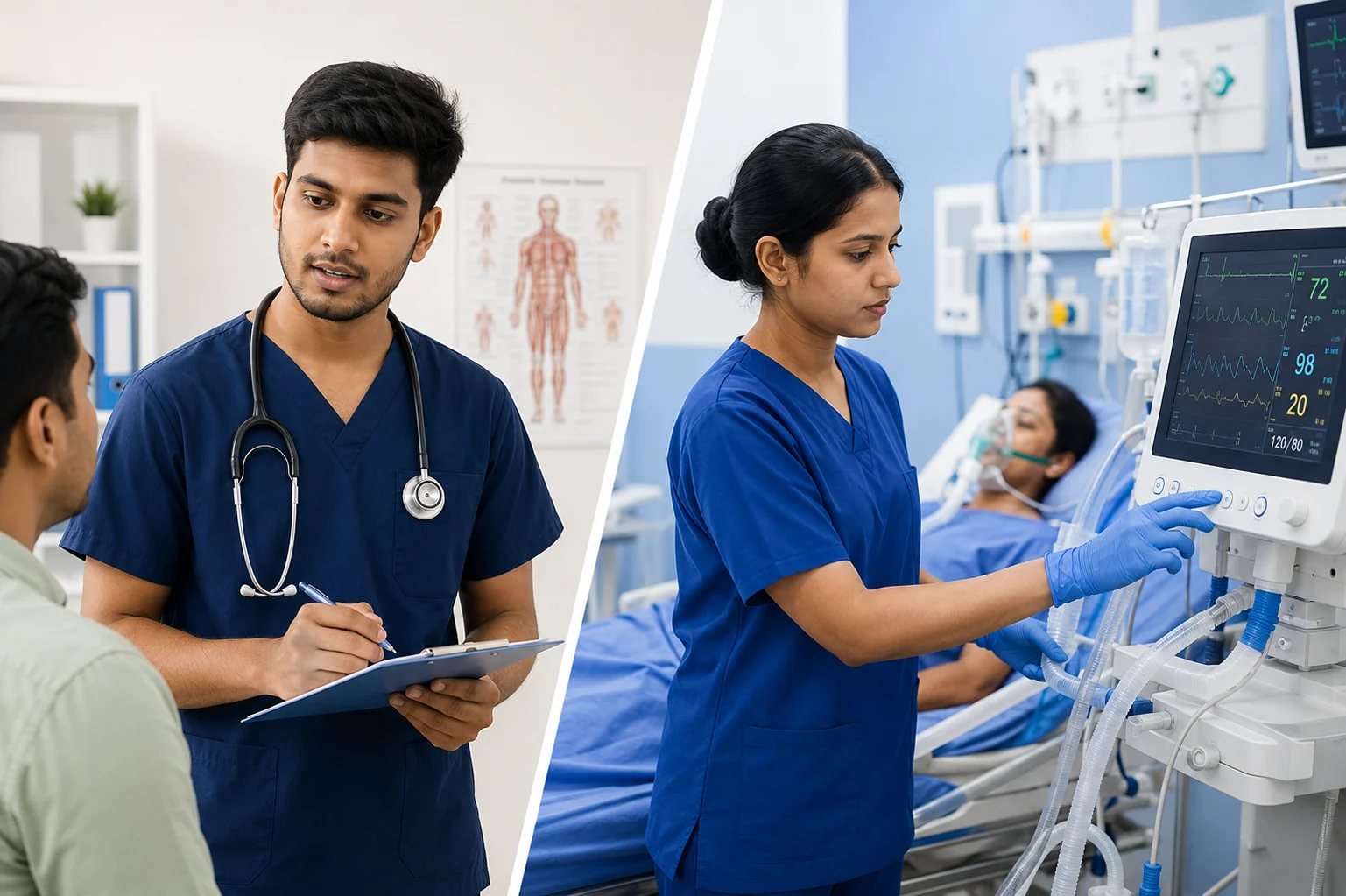
B.Sc. Physician Assistant is a course that trains students to work closely with doctors in diagnosing, treating, and managing patients. A Physician Assistant supports physicians during consultations, assists in minor procedures, takes patient histories, and helps in day-to-day clinical decision-making.
Physician Assistants typically work in hospitals, outpatient departments, clinics, and specialty care units. The role suits students who enjoy direct patient interaction and want a career close to clinical medicine without pursuing an MBBS.
What Is B.Sc. Critical Care Technology?
B.Sc. Critical Care Technology prepares students to manage patients in high-dependency and emergency situations. A Critical Care Technologist works in Intensive Care Units (ICUs), handling ventilators, monitoring vital signs, and assisting doctors during emergencies and critical interventions.
This role is focused almost entirely on ICU, trauma, and emergency care settings. It suits students who can stay calm under pressure and are drawn to fast-paced, life-saving environments.
Curriculum Comparison
Both courses share a common foundation in anatomy, physiology, and pharmacology during the early semesters. From there, B.Sc. Physician Assistant leans toward clinical diagnosis, general medicine, and patient assessment, while B.Sc. Critical Care Technology focuses more on ICU management, ventilator handling, and emergency/trauma care, with clinical internships built into both.
Eligibility Criteria
Admission requirements for both programmes at HIHS Haldia, West Bengal, follow the norms set by WBUHS (West Bengal University of Health Sciences), the university with which the institute is affiliated.
B.Sc. Physician Assistant:
Passed Class 12 with Physics, Chemistry, and Biology (PCB)
Minimum 45–50% aggregate marks (varies by category)
Admission through JENPAS UG, the entrance examination conducted by the West Bengal Joint Entrance Examinations Board (WBJEEB), followed by counselling
B.Sc. Critical Care Technology:
Passed Class 12 with Physics, Chemistry, and Biology (PCB)
Minimum 45–50% aggregate marks (varies by category)
Admission through JENPAS UG, the entrance examination conducted by the West Bengal Joint Entrance Examinations Board (WBJEEB), followed by counselling
Career Prospects & Job Roles
Both courses open doors across government and private healthcare sectors, but the work settings differ.
Career options after B.Sc. Physician Assistant:
Physician Assistant in hospitals and clinics
Clinical Assistant in specialty departments (cardiology, orthopedics, etc.)
Diagnostic and outpatient care support
Roles in government health programmes
Further studies leading to hospital administration or clinical research
Career options after B.Sc. Critical Care Technology:
ICU Technologist/Technician
Emergency and Trauma Care Technician
Ventilator and Life Support Specialist
Ambulance and pre-hospital care roles
Positions in multi-specialty hospital ICUs and diagnostic centres
Which Course Should You Choose?
The right choice depends on personal interest and temperament. Students who enjoy talking to patients, understanding symptoms, and assisting in diagnosis and treatment planning may find B.Sc. Physician Assistant is more fulfilling. It suits those who want a career closer to general clinical practice.
Students who are drawn to emergency situations, enjoy working with equipment like ventilators and monitors, and can stay composed under pressure may prefer B.Sc. Critical Care Technology. It suits those who want fast-paced, high-stakes work in ICUs and trauma units.
Why Choose HIHS for B.Sc. PA or B.Sc. CCT
HIHS Haldia, established in 2003 under ICARE and affiliated with WBUHS, offers both B.Sc. Physician Assistant and B.Sc. Critical Care Technology with experienced faculty and well-equipped labs. Students benefit from hands-on clinical internships in partner hospitals, giving them real exposure before graduation. A dedicated placement cell also helps guide students toward suitable job opportunities after course completion.
Frequently Asked Questions
Q1. What is the eligibility for B.Sc. PA and B.Sc. CCT at HIHS Haldia?
Both courses require Class 12 pass with Physics, Chemistry, and Biology (PCB), along with the minimum aggregate marks set by WBUHS admission norms.
Q2. How long are these courses?
Both B.Sc. Physician Assistant and B.Sc. Critical Care Technology are typically 3 to 4 years in duration, including internship/clinical training, as per WBUHS curriculum guidelines.
Q3. Can students pursue further studies after these courses?
Yes. Graduates can pursue M.Sc. in the respective specialisation, hospital administration courses, or certification programmes to deepen their expertise and improve career prospects.
Q4 : Are these courses recognised for government hospital jobs?
Yes. Since both courses are affiliated with WBUHS, graduates are eligible to apply for government hospital and healthcare department positions along with private sector roles.
Ready to Take the Next Step?
Choosing between B.Sc. Physician Assistant and B.Sc. Critical Care Technology comes down to what kind of healthcare role feels right for each student - one closer to diagnosis and patient consultation, the other rooted in emergency and ICU care. Both paths lead to meaningful, in-demand careers in India's growing healthcare sector. Students and parents in West Bengal looking to explore these options are encouraged to reach out to HIHS Haldia for detailed counselling, campus visits, or to apply for the upcoming academic session.

