



Blog
Bachelor of Anaesthesia & Operation Theatre Technology (AOTT): Course Details, Eligibility and Career Scope
The operation theatre is one of the most demanding and highly regulated environments in a hospital, and it cannot function without a team of skilled technical professionals working quietly behind the scenes. Among the paramedical careers that have grown steadily in demand across West Bengal and India in recent years, Operation Theatre Technology has emerged as a particularly rewarding option for students with an interest in surgery, patient care and hospital systems. The Bachelor of Anaesthesia & Operation Theatre Technology, commonly known as AOTT, is a full-time undergraduate programme offered by the Haldia Institute of Health Sciences (HIHS), Haldia, designed to prepare students for exactly this role.
This blog looks at what the AOTT programme at HIHS Haldia involves, who is eligible to apply, what students study during the course, and the career opportunities that follow graduation.
What is Bachelor of Anaesthesia & Operation Theatre Technology?
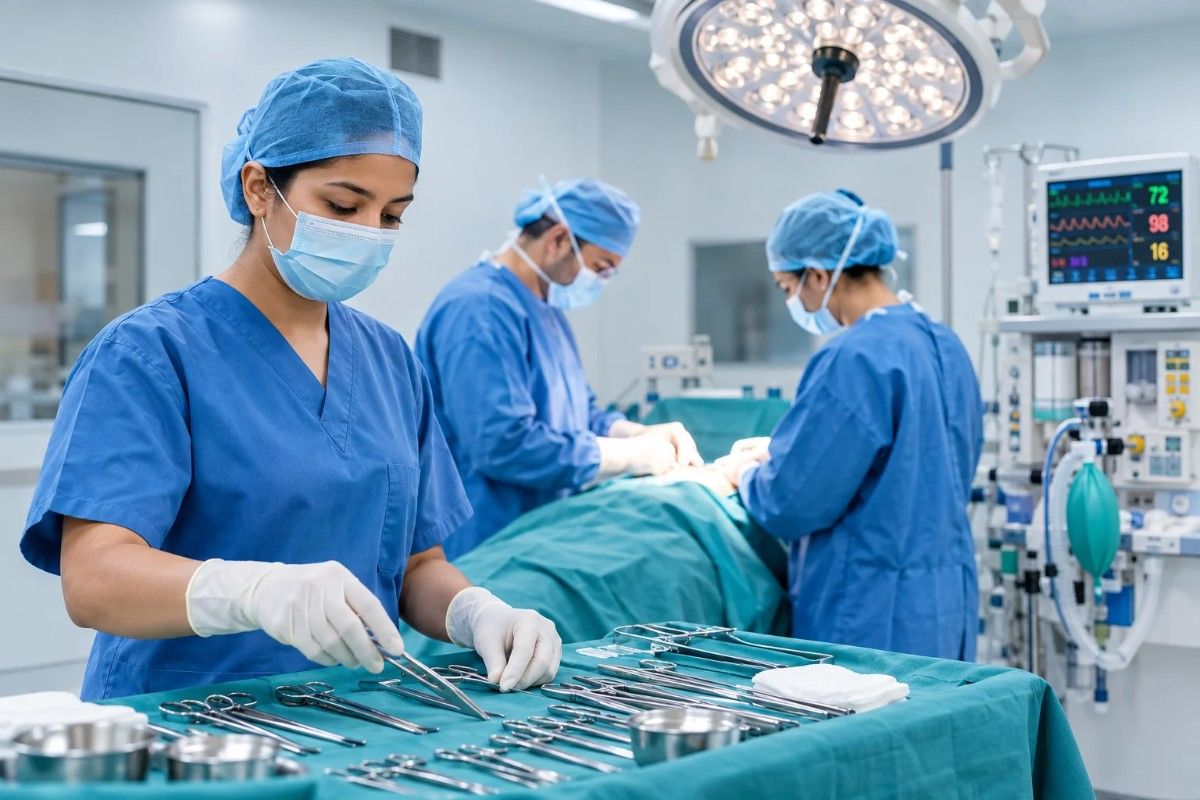
Operation Theatre Technology is the applied science of assisting surgical teams before, during and after operative procedures. An Operation Theatre Technician is responsible for preparing the operating room, sterilising and arranging surgical instruments, assisting anaesthetists and surgeons during procedures, and maintaining the strict standards of asepsis that every operation theatre demands. It is a role that combines technical precision with calm, methodical teamwork, since even a small lapse in preparation can affect the outcome of a surgery.
The AOTT programme at HIHS Haldia is a degree-level course that trains students in this discipline from the ground up, combining classroom learning in the medical sciences with practical, hands-on training inside real hospital operation theatres.
Why choose HIHS Haldia for AOTT?
Haldia Institute of Health Sciences was established in 2003 under the Indian Centre for Advancement of Research and Education (ICARE), and has since built a reputation as one of the leading paramedical institutions in West Bengal. The AOTT programme is offered under the Department of Science & Management alongside related allied health courses, giving students access to a well-established academic ecosystem, experienced faculty and clinical training facilities attached to the ICARE group of institutions.
Choosing a college with strong hospital affiliations matters a great deal in a course like this, because Operation Theatre Technology is learned as much in the theatre as in the classroom. Students at HIHS Haldia get structured exposure to live surgical environments as part of their training, which builds the confidence and technical competence that employers look for at the point of recruitment.
Eligibility criteria for AOTT
Admission to the AOTT programme at HIHS Haldia requires candidates to have passed their higher secondary examination, or its equivalent, with a minimum of 50 per cent marks in Physics, Chemistry and Biology. The programme has an intake capacity of 10 seats, which allows for closer faculty attention and more focused practical training than is possible in larger batches.
Students who have completed their higher secondary education from the Science stream with Physics, Chemistry and Biology as core subjects, and who meet the minimum marks requirement, are encouraged to apply. Prospective candidates are advised to check the current academic year's admission notice on the HIHS Haldia website for exact application timelines and documentation requirements.
Syllabus and course structure
The AOTT curriculum at HIHS Haldia is designed to build a strong foundation in human biology before progressing into the specialised subjects that directly relate to operation theatre practice, including anaesthesia, clinical surgery, sterilisation protocols and hospital instrumentation. This broad but focused syllabus ensures that graduates leave HIHS Haldia not only familiar with the technical processes of the operation theatre, but also with a working understanding of the wider clinical context in which surgical teams operate.
Career prospects after AOTT
Graduates of the AOTT programme at HIHS Haldia have several career paths open to them once they complete the course. The most direct route is employment as an Operation Theatre Technician in Central or State Government hospitals and other healthcare services, a role that sits at the heart of every surgical department and is in consistent demand across public and private healthcare systems alike.
Graduates who wish to move into teaching are also eligible to be recruited as a Demonstrator or Clinical Tutor at institutes that conduct courses on Operation Theatre Technology, allowing experienced professionals to train the next generation of technicians. A further option available to AOTT graduates are working as a Medical Transcriptionist, which draws on the detailed clinical knowledge gained during the programme.
Where can AOTT graduates work?
Beyond these specific roles, AOTT graduates are well placed to build careers across general and specialty hospitals, nursing homes, diagnostic and day-care surgical centres, and government health missions, wherever operation theatres are in use. As healthcare infrastructure continues to expand across West Bengal and the rest of India, the demand for trained, degree-qualified operation theatre professionals is expected to remain strong.
Why Operation Theatre Technology is a good career choice
Operation Theatre Technology offers a career that is stable, hands-on and directly connected to patient outcomes. Unlike some allied health roles that operate at a distance from the point of treatment, an Operation Theatre Technician works right alongside surgeons and anaesthetists during some of the most critical moments in a patient's care. For students who want a career that is technically engaging, team-oriented and genuinely essential to hospital functioning, AOTT is a strong choice, and one that comes with clearer routes into government and institutional employment than many other undergraduate options.
The degree-level structure of the programme at HIHS Haldia also gives graduates an advantage over diploma-holders when it comes to career progression, since a degree qualification opens the door to postgraduate study and senior clinical or academic roles further down the line. It also tends to be viewed favourably in recruitment for supervisory or coordinating positions within larger operation theatre complexes, where a degree-holder is often preferred over a diploma-holder for team-leading responsibilities.
The role also suits students who enjoy working under pressure in a structured setting. Every procedure in an operation theatre follows a defined protocol, from the initial preparation of the room and instruments to the post-operative handover, and technicians who are naturally organised and detail-oriented tend to find real satisfaction in this kind of work. Because the operation theatre team functions as a close unit, the course also builds strong interpersonal and communication skills alongside the technical curriculum, both of which matter a great deal once graduates step into a working hospital environment.
Skills students gain during the programme
Beyond the subject knowledge covered in the syllabus, the AOTT programme is designed to build a set of practical skills that graduates carry directly into their working lives. Students learn to prepare and maintain surgical instrument sets, follow strict sterilisation and infection-control protocols, and understand the sequence of a surgical procedure closely enough to anticipate what a surgeon or anaesthetist will need next.
Training also covers patient positioning and safety during surgery, correct handling and disposal of biomedical waste, and basic troubleshooting of operation theatre equipment. Because much of this is taught through supervised clinical postings rather than lectures alone, students graduate with genuine working familiarity with a live operation theatre, not just theoretical knowledge of how one functions. This combination of classroom learning and clinical exposure is one of the main reasons employers continue to value degree-qualified operation theatre technicians over candidates trained through shorter or purely theoretical courses.
Frequently Asked Questions
What is the eligibility for AOTT at HIHS Haldia?
Candidates must have passed their higher secondary examination, or its equivalent, with at least 50 per cent marks in Physics, Chemistry and Biology.
How many seats are available for AOTT?
The programme has an intake capacity of 25 seats at HIHS Haldia..
What jobs can I get after completing AOTT?
Graduates can work as Operation Theatre Technicians in Central or State Government hospitals and other healthcare services, as Demonstrators or Clinical Tutors at institutes offering Operation Theatre Technology courses, or as Medical Transcriptionists.
Is AOTT a good career option in West Bengal?
Yes. With hospitals and surgical centres across West Bengal continuing to expand, demand for qualified, degree-holding operation theatre professionals remains consistently strong, making AOTT a practical and future-facing career choice.
Contact Us
For admission enquiries, detailed fee structure and application timelines for the Bachelor of Anaesthesia & Operation Theatre Technology programme, prospective students and parents can get in touch with Haldia Institute of Health Sciences directly.

