



Blog
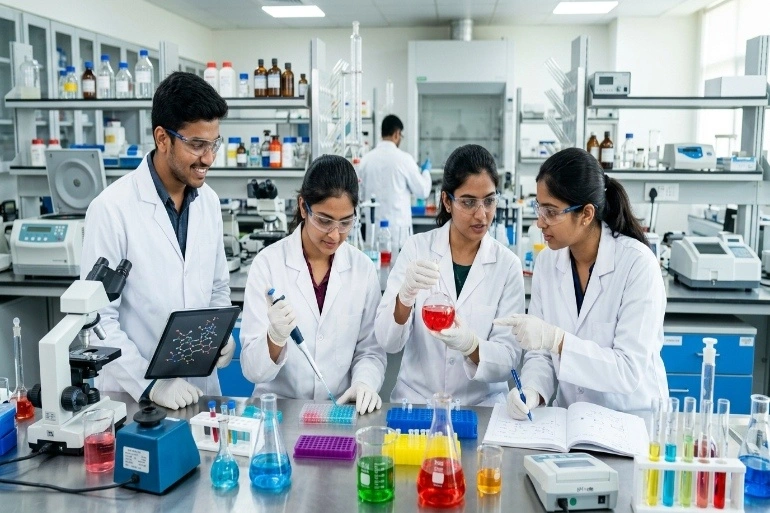
M.Sc. in Medical Laboratory Technology (Biochemistry) at HIHS Haldia - Eligibility, Curriculum & Career Opportunities
Walk into any diagnostic centre in Kolkata, Haldia, or a district town anywhere in West Bengal today, and you will notice something: the queue at the biochemistry counter rarely gets shorter. Lipid profiles, liver function tests, thyroid panels, HbA1c screenings, cardiac markers - these are no longer occasional requisitions but the daily bread of India's pathology sector. As lifestyle diseases such as diabetes, hypertension, and metabolic syndrome continue to rise across both urban and semi-urban India, clinical biochemistry has quietly become one of the busiest and most indispensable specialisations within laboratory medicine. For a BMLT or B.Sc. MLT graduate wondering what comes next, Haldia Institute of Health Sciences (HIHS) offers precisely the kind of postgraduate specialisation that sits right at the heart of modern diagnostics.
The Science Behind Every Blood Report You've Ever Seen
An M.Sc. in Medical Laboratory Technology with a specialisation in Biochemistry trains graduates to move beyond routine sample processing into the analytical and diagnostic core of laboratory science. Where the Microbiology track focuses on identifying pathogens, culturing organisms, and studying infectious disease, the Biochemistry specialisation is concerned with the chemistry of the human body itself - enzymes, hormones, metabolites, electrolytes, and the biochemical markers that reveal how organs and systems are functioning. Students on this track learn to operate and interpret results from sophisticated clinical chemistry analysers, understand the biochemical basis of disease, and develop the analytical judgement needed to flag abnormal results that matter clinically. It is a specialisation that suits those who enjoyed the chemistry-heavy modules of their undergraduate MLT course and want to deepen that expertise into a career built on precision, accuracy, and diagnostic insight.
Who Can Apply, and How the Door Opens at HIHS
Admission to the M.Sc. MLT (Biochemistry) programme at Haldia Institute of Health Sciences is designed for graduates who already hold a BMLT or B.Sc. in Medical Laboratory Technology from a recognised university, ideally with a sound academic record in their qualifying degree. As with other postgraduate paramedical programmes in the state, admission is governed by the norms set out by the West Bengal University of Health Sciences (WBUHS), to which HIHS Haldia is affiliated. This means candidates should be prepared for counselling-based admission processes, verification of academic transcripts, and adherence to eligibility percentages as prescribed by WBUHS guidelines for a given academic session. Because these requirements are reviewed and occasionally revised by the university, prospective students are always encouraged to confirm the current year's exact eligibility criteria, application windows, and any entrance formalities directly with the HIHS admissions office before applying, so that they can plan their documentation and timelines with confidence.
Two Years That Turn Technicians into Specialists
The programme is structured as a two-year postgraduate course, typically divided into four semesters that combine rigorous classroom learning with substantial hands-on laboratory training, in keeping with the WBUHS curriculum framework for M.Sc. MLT programmes. The overall design moves students from strengthening their theoretical grounding in advanced clinical biochemistry towards deep, applied exposure in the laboratory, so that by the final semesters much of the learning happens directly at the bench rather than in the classroom. Considerable emphasis is placed on mastering the instrumentation and analytical techniques used in modern clinical chemistry laboratories, alongside the quality control practices that any accredited diagnostic facility depends on. Research methodology also forms part of the curriculum, preparing students for dissertation work and, for those inclined, further academic pursuits later on. Throughout the two years, laboratory postings and practical rotations ensure that graduates leave not merely with theoretical knowledge but with the applied competence that employers actively look for. As with all specifics of the syllabus, students are encouraged to refer to the detailed, semester-wise curriculum shared by HIHS at the time of admission, since course structures are periodically updated in line with WBUHS guidelines.
Where This Degree Can Take You
Graduates of the M.Sc. MLT (Biochemistry) programmes find themselves well placed across a wide spectrum of the healthcare and diagnostics industry. Many step into roles as biochemistry laboratory in-charges or senior technologists within hospital pathology departments, where their expertise in interpreting complex biochemical panels is highly valued. The diagnostic chain industry - from large national players to regional diagnostic centres across West Bengal and eastern India - regularly seeks trained biochemistry specialists to manage automated analyser operations, quality assurance, and reporting accuracy. Beyond direct laboratory work, opportunities extend to research institutions and pharmaceutical or biotechnology companies involved in clinical trials and assay development, where a strong grounding in biochemical analysis is essential. Some graduates move into teaching and academic roles at paramedical colleges, training the next generation of MLT students, while others use the postgraduate qualification as a stepping stone into laboratory administration and quality management positions as their careers mature.
Why Haldia Makes Sense for This Specialisation
Choosing where to pursue a postgraduate specialisation matters as much as choosing the specialisation itself, and Haldia Institute of Health Sciences offers a combination of factors that make it a sound choice for BMLT and B.Sc. MLT graduates in the region. As an institution affiliated to the West Bengal University of Health Sciences, HIHS ensures that its curriculum, examinations, and degree stay firmly aligned with recognised state standards, giving graduates a qualification that carries credibility across West Bengal's healthcare sector. The institute's laboratories are equipped to give students genuine hands-on exposure to the instrumentation and techniques used in modern clinical biochemistry, rather than leaving practical learning to chance. Being based in Haldia, an industrial and healthcare hub of East Medinipur with strong connectivity to Kolkata, also means students benefit from a growing local ecosystem of hospitals and diagnostic centres for clinical postings and placement opportunities. HIHS further supports students through dedicated placement assistance, helping bridge the gap between classroom learning and the first step into a professional laboratory career, which is often the part of postgraduate study that matters most to anxious final-year students.
Quick Answers to Common Questions
Who is eligible for M.Sc. MLT (Biochemistry) at HIHS?
Candidates who hold a BMLT or B.Sc. in Medical Laboratory Technology from a recognised university, meeting the eligibility norms prescribed by WBUHS for the relevant academic session, are eligible to apply.
How long is the course?
It is a two-year postgraduate programme, generally structured across four semesters combining theoretical study with practical laboratory training.
How is this different from the Microbiology specialisation?
While Microbiology focuses on pathogen identification, culturing, and infectious disease diagnostics, Biochemistry centres on the chemical and metabolic workings of the body, training students to analyse and interpret the biochemical markers used in diagnosing a wide range of clinical conditions.
Can I pursue a Ph.D. after this M.Sc.?
Yes, the programme's research methodology and dissertation components lay useful groundwork for candidates who wish to pursue doctoral studies or research-oriented careers in biochemistry or allied life sciences later on.
Does HIHS help with placements after the course?
HIHS Haldia provides placement support to help connect graduating students with hospitals, diagnostic centres, and laboratories seeking trained biochemistry specialists.
If you are a BMLT or B.Sc. MLT graduate ready to turn your interest in clinical chemistry into a specialised, in-demand career, get in touch with the HIHS Haldia admissions team today to learn more about the M.Sc. MLT (Biochemistry) programme and how to apply.
Contact Us
For admission enquiries, eligibility guidance, or details on the M.Sc. MLT (Biochemistry) programme, reach out to the Haldia Institute of Health Sciences admissions office directly. Our counsellors are happy to walk you through the WBUHS-affiliated curriculum, current intake schedule, and application process. You may visit the HIHS Haldia campus in person or contact the admissions team by phone or email for prompt assistance. We look forward to helping you take the next step in your laboratory sciences career.

